📈 Project pulse
Live public activity from the GitHub repository.
—Stars
—Forks
—Open issues
Loading live repository data…
A survey of how foundation model-based agents improve themselves through model updates, intrinsic demonstrations, intrinsic evaluative feedback, extrinsic experience, prompt evolution, memory, tool use, and recursive scaffolding.
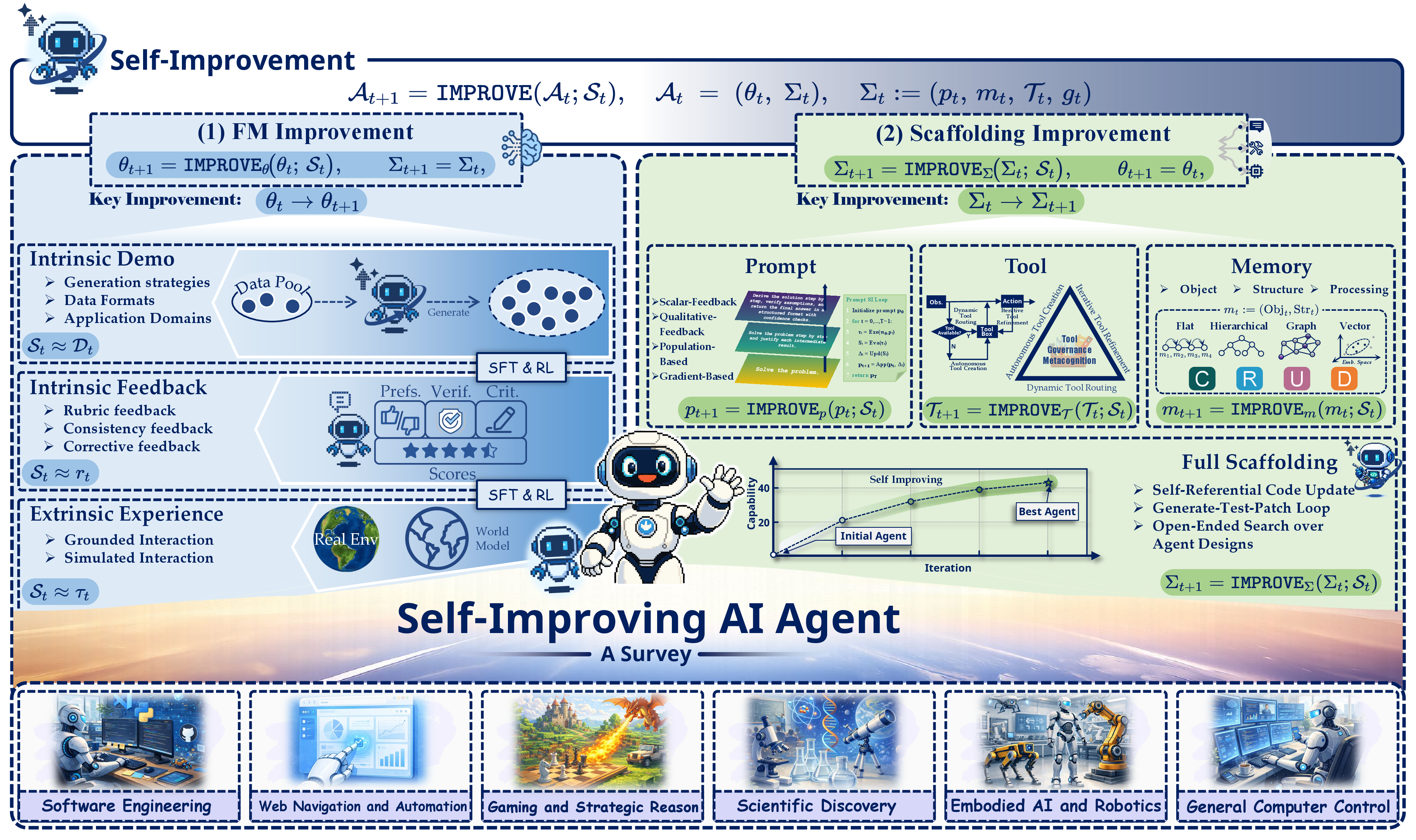
Foundation model-based agents are moving from static prompt-following systems toward systems that can improve themselves over time. This survey organizes self-improvement mechanisms into two major branches: foundation model improvement, which updates the model itself, and scaffolding improvement, which updates surrounding components such as prompts, memory, tools, and executable agent logic. A third branch, evaluation & benchmarking, organizes how improvement is measured and compared.
Across the survey, the central distinction is between improving the underlying foundation model and improving the scaffolding around it. This distinction provides a practical way to compare methods, interpret learning signals, and connect representative papers to broader research trends.
Core distinction. Self-improvement can be framed by asking what is being updated.
The survey can be read as a structured map of how an FM-based agent improves itself. Each item below links directly into the corresponding literature section.
These are not the only important papers in the survey. They are included here as a first reading path for readers who want to understand the landscape quickly before diving into the full library.
A canonical example of self-synthetic instruction generation for model alignment.
An influential AI-feedback framework where model-based judgments are used for alignment and policy optimization.
A representative web-agent training setup built around reinforcement learning and evolving curricula.
A concrete example of using learned environment dynamics to improve web agents.
A classic self-feedback loop for iterative improvement at the prompt/output level.
An influential formulation of automatic optimization via textual gradients.
A representative long-term memory architecture for LLM-based agents.
An open-ended embodied agent that accumulates skills and uses tools in a growing scaffold.
A strong representative for recursive self-improving agents that modify their broader operating logic.
The literature below is organized to match the survey taxonomy across three branches: foundation model improvement, scaffolding improvement, and evaluation & benchmarking. Within each subsection, entries are presented in roughly chronological order.
The agent or model improves by synthesizing demonstrations, instruction sets, reasoning traces, or task distributions that can be used for imitation-style parameter updates.
The system derives its own reward, critique, verification signal, or intrinsic supervision to guide further updates.
The agent improves through trajectories gathered from interaction with environments or learned simulators.
Learning from trajectories, rewards, or observations obtained by acting in executable environments such as code runtimes, web interfaces, games, GUI systems, or robotics simulators.
Using learned world models, simulators, or imagined rollouts to improve agent behavior.
The agent improves the prompt layer through scoring, reflection, evolutionary search, or textual-gradient style updates.
Optimizing prompts with scalar objectives, scores, or evaluation signals.
| Year | Title | Venue | Links |
|---|---|---|---|
| 2022 | Large Language Models Are Human-Level Prompt Engineers | arXiv | Paper · Code |
| 2024 | Large Language Models as Optimizers | ICLR | Paper · Code |
| 2024 | Prompt Refinement with Image Pivot for Text-to-Image Generation | ACL | Paper · Code |
| 2024 | Learning from Contrastive Prompts: Automated Optimization and Adaptation | arXiv | Paper · Code |
| 2024 | PRompt Optimization in Multi-Step Tasks (PROMST): Integrating Human Feedback and Heuristic-based Sampling | EMNLP | Paper · Code |
| 2025 | The Prompt Alchemist: Automated LLM-Tailored Prompt Optimization for Test Case Generation | arXiv | Paper · Code |
| 2025 | DRO-InstructZero: Distributionally Robust Prompt Optimization for Large Language Models | arXiv | Paper · Code |
| 2025 | CoolPrompt: Automatic Prompt Optimization Framework for Large Language Models | FRUCT | Paper · Code |
| 2026 | SePO: Self-Evolving Prompt Agent for System Prompt Optimization | arXiv | Paper · Code |
| 2026 | SAGE: Stochastic Prompt Optimization via Agent-Guided Exploration | arXiv | Paper · Code |
Improving prompts through critiques, revisions, hindsight, or other natural-language feedback.
Evolving prompt populations with selection, mutation, or other population-based search methods.
Treating language feedback like gradients for automatic textual optimization.
The agent improves what it stores, how memory is structured, and how memory is processed across interactions.
What is stored in memory, such as notes, summaries, trajectories, or latent states.
How memory is organized, indexed, retrieved, or represented over time.
How memory is created, updated, compressed, retrieved, and otherwise processed over time.
The agent improves which tools it uses, how tools are routed, and whether it can refine or create new tools itself.
Choosing, orchestrating, and routing among available tools as tasks and contexts evolve.
Improving tool use through iterative practice, feedback, debugging, or skill refinement.
Generating or assembling new tools, services, or agent capabilities on demand.
The most ambitious setting: the agent revises its own broader operational logic or executable scaffold.
Evaluation and benchmark literature is integrated here as the third branch of the Curated Paper Library.
| Year | Title | Venue | Links |
|---|---|---|---|
| 2025 | Agent-as-a-Judge: Evaluate Agents with Agents | ICML | Paper · Code |
| 2025 | Evaluation Agent: Efficient and Promptable Evaluation Framework for Visual Generative Models | ACL | Paper · Code |
| 2025 | EvalAgent: Discovering Implicit Evaluation Criteria from the Web | COLM | Paper · Code |
| 2025 | Learning to Align Multi-Faceted Evaluation: A Unified and Robust Framework (ARJudge) | ACL Findings | Paper · Code |
| 2025 | VerifiAgent: A Unified Verification Agent in Language Model Reasoning | EMNLP Findings | Paper · Code |
Foundation-Model-Level
| Year | Title | Venue | Links |
|---|---|---|---|
| 2024 | SWE-Bench+: Enhanced Coding Benchmark for LLMs | arXiv | Paper · Code |
| 2024 | Identifying the Risks of LM Agents with an LM-Emulated Sandbox | ICLR | Paper · Code |
| 2025 | GitTaskBench: A Benchmark for Code Agents Solving Real-World Tasks Through Code Repository Leveraging | arXiv | Paper · Code |
Scaffold-Level
| Year | Title | Venue | Links |
|---|---|---|---|
| 2024 | MINT: Evaluating LLMs in Multi-Turn Interaction with Tools and Language Feedback | ICLR | Paper · Code |
| 2024 | TaskBench: Benchmarking Large Language Models for Task Automation | NeurIPS | Paper · Code |
| 2024 | MetaTool Benchmark for Large Language Models: Deciding Whether to Use Tools and Which to Use | ICLR | Paper · Code |
| 2025 | The Berkeley Function Calling Leaderboard (BFCL): From Tool Use to Agentic Evaluation of Large Language Models | ICML | Paper · Code |
| 2026 | DrunkAgent: Stealthy Memory Corruption in LLM-Powered Recommender Agents | WWW | Paper · Code |
| 2026 | RSI-Bench: Multi-Axis Benchmark for Recursive Self-Improvement | GitHub | Paper · Code |
Software Engineering
Web Navigation
| Year | Title | Venue | Links |
|---|---|---|---|
| 2023 | Mind2Web: Towards a Generalist Agent for the Web | NeurIPS | Paper · Code |
| 2024 | WebArena: A Realistic Web Environment for Building Autonomous Agents | ICLR | Paper · Code |
| 2024 | VisualWebArena: Evaluating Multimodal Agents on Realistic Visual Web Tasks | ICLR Workshop | Paper · Code |
| 2024 | WebCanvas: Benchmarking Web Agents in Online Environments | ICML Workshop | Paper · Code |
| 2026 | ST-WebAgentBench: A Benchmark for Evaluating Safety and Trustworthiness in Web Agents | ICLR | Paper · Code |
Gaming & Strategy
Scientific Discovery
Embodied AI
General Computer Control
Start with the overview and taxonomy, then read one representative paper from each branch in the quick-start section.
After that, use the paper library to go deeper into whichever mechanism matches your interests: model updates, prompt evolution, memory, tools, or recursive scaffolds.
Jump directly to the literature tables. The search bar works best for titles and venues, while the filter buttons quickly separate foundation-model improvement, scaffolding improvement, and evaluation & benchmarking entries.
For deeper reading, use the search bar and filters to move between broad categories and more specific mechanisms.
This survey is maintained as a living research map. Read the discussion, suggest missing work, report corrections, or help improve the taxonomy.
Live public activity from the GitHub repository.
Discuss the survey and follow its public community activity.
Every correction and missing reference makes the survey more useful.
Leave a question, reading note, or suggestion directly from this page. Comments are attached to a public GitHub thread, so the conversation remains searchable and easy to moderate.
Please cite this survey as follows.
@misc{ren2026selfimprovementsmodernagenticsystems,
      title={Self-Improvements in Modern Agentic Systems: A Survey},
      author={Zhe Ren and Yimeng Chen and Dandan Guo and Guowei Rong and Tonghui Li and R. B. Xiong and Qingfeng Lan and Wenyi Wang and Li Nanbo and Yibo Yang and Mingchen Zhuge and Jürgen Schmidhuber},
      year={2026},
      eprint={2607.13104},
      archivePrefix={arXiv},
      primaryClass={cs.AI},
      url={https://arxiv.org/abs/2607.13104},
}